

There is a moment, right after you bite into a translucent little cube of nata jelly, when something unexpected happens. It resists you, just slightly, then springs back with a bounce that no gummy, no gelatin, and no ordinary jelly cube has ever managed to replicate. That sensation is not an accident. It is the result of one of the most quietly fascinating fermentation processes in all of food science, and it starts with something as simple as coconut water.
Table of Contents
What Is Nata de Coco and Why Does Everyone Love the Texture?
From Coconut Water to Coconut Gel Cubes: The Origin Story
If you want to understand what is nata de coco, you have to travel back to the Philippines in the nineteenth century, where fermented coconut water was already producing a thick, white gel that local communities had learned to harvest and enjoy. The name comes from Spanish, meaning “cream of coconut,” and the product is essentially a firm, chewy, translucent gel made entirely from fermented coconut water. Those coconut gel cubes you see floating in bubble tea, shaved ice, and dessert bowls worldwide are the direct descendants of that original discovery.
What Are Jubes and How Do They Fit Into the Nata de Coco World?
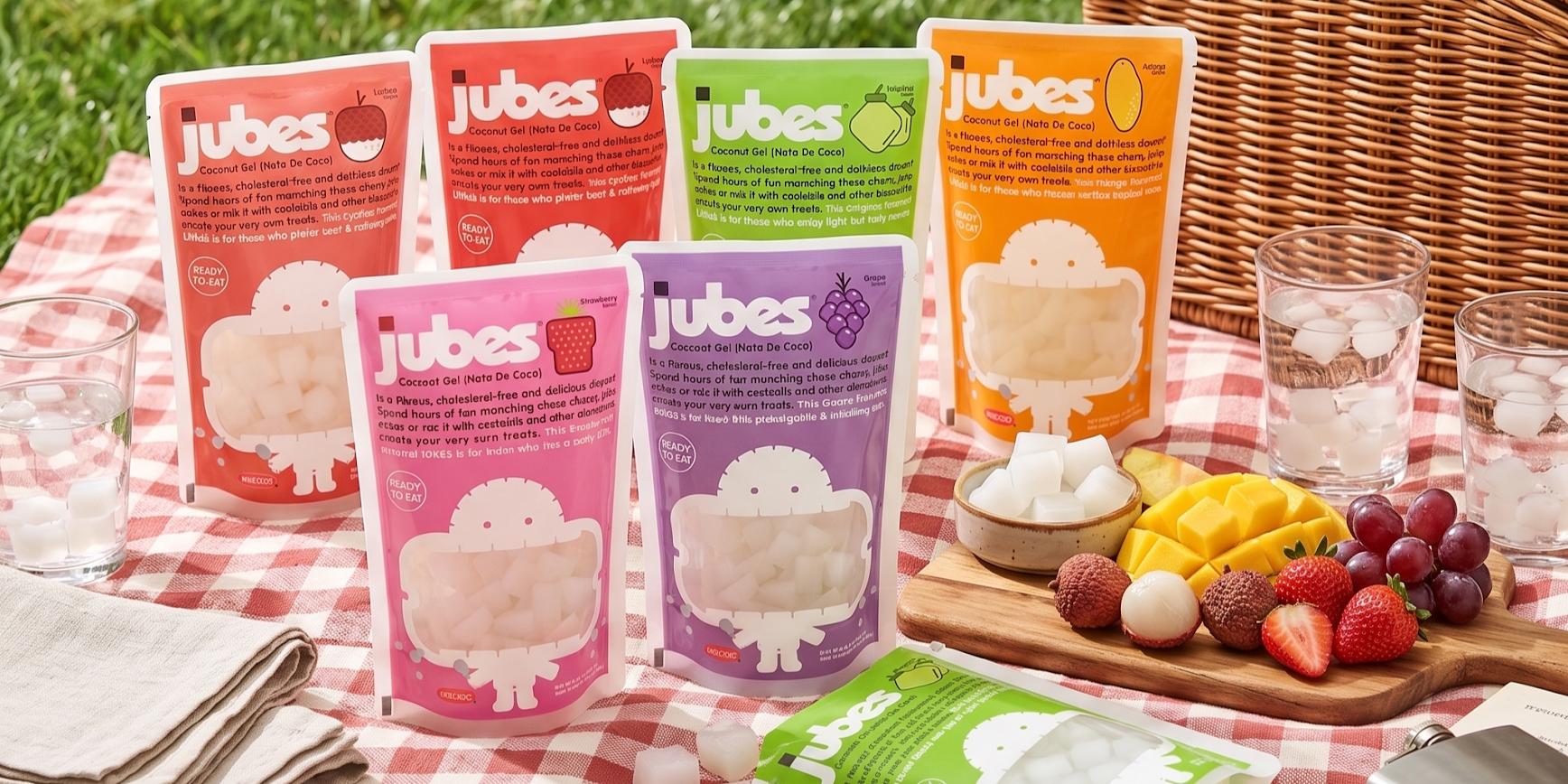
Jubes are a premium ready-to-eat brand of coco jelly cubes made from fermented coconut water, available in Original, Grape, Lychee, Mango, and Strawberry flavors. Each pack delivers the same bouncy, springy texture with a light sweet-tangy flavor profile. Jubes are fat-free, cholesterol-free, high in fiber, free from artificial colors, and certified Halal. They are the kind of snack that works straight from the pack or as a topping for drinks and dessert bowls.
Why the Chew Feels So Different From Gummies or Regular Jelly Cubes
Gummies rely on gelatin, an animal-derived protein that melts at body temperature. Agar jelly is brittle and breaks cleanly. Neither of them can do what bacterial cellulose does, which is build a three-dimensional fiber network that behaves more like a flexible sponge than a solid gel. That network holds water inside its structure while staying firm on the outside, which is exactly why coconut cubes snap back after every bite instead of dissolving or crumbling.
The Fermentation Science: How Bacteria Build That Bouncy Bite
Meet Komagataeibacter xylinus: The Microbe Behind the Magic
The entire magic of nata jelly begins with a single species of bacteria called Komagataeibacter xylinus. This remarkable microorganism consumes the sugars naturally present in coconut water and, as a byproduct of that metabolic process, excretes long chains of pure cellulose. These chains are not random. They are arranged with extraordinary precision into ribbon-like fibers that weave together into an increasingly dense mat floating at the surface of the liquid.
How Bacterial Cellulose Forms a Network That Creates Nata Jelly
As the bacteria multiply and work, billions of individual cellulose ribbons cross and bond with each other, trapping water molecules inside the spaces between fibers. The result after roughly two weeks of undisturbed fermentation is a thick, white, rubbery sheet of bacterial cellulose that can be several centimeters deep. This is not a gel in the traditional chemical sense. It is a living-built scaffold, and that is precisely why its texture is so unique compared to anything made from agar or gelatin.
Why pH and Temperature Are the Secret Controls of Texture and Quality
Producers carefully maintain the fermentation environment to control the final product. The pH of the coconut water is kept mildly acidic, usually between 4 and 5, which keeps unwanted microbes out while allowing K. xylinus to thrive. Temperature is held steady, typically between 28 and 31 degrees Celsius, because even small fluctuations can affect how tightly the cellulose fibers pack together, which directly changes the chew of the final jelly cubes.
From Fermentation Tank to Perfect Coconut Cubes: The Production Process
How the Gel Sheet Is Harvested, Washed, and Cut Into Uniform Coco Jelly Cubes
Once fermentation is complete, the gel sheet is carefully lifted from the liquid and enters a rigorous washing process. This step is critical because it removes the acetic acid built up during fermentation, neutralizes the pH, and eliminates any residual bacterial activity. After washing, the sheet is boiled, then cut into the small, uniform coconut cubes that are recognizable in every pack. They are then soaked in flavored syrup before packaging, which is how varieties like lychee coconut jelly and mango coco jelly get their distinctive character.
Food Safety Certifications That Make Commercial Nata Jelly Trustworthy
Jubes products carry the SNI ISO 9001:2015 Quality Management System certification, HACCP certification, and a Halal Assurance System certification, along with a registered US trademark. These credentials reflect the controlled production standards behind every pack of juicy cubes that reaches consumers in the United States.
Why Bacterial Cellulose Is Not Like Agar or Gelatin on a Molecular Level
Agar is a polysaccharide derived from seaweed that forms gels through hydrogen bonding when cooled. Gelatin is a protein that melts when warm. Bacterial cellulose, by contrast, is an insoluble crystalline fiber that does not melt, does not dissolve in water, and does not rely on temperature to maintain its structure. This is the molecular reason why nata jelly cubes stay perfectly chewy even in hot drinks or warm dessert bowls.
The Nutritional and Sensory Science Behind Every Juicy Bite
Bacterial Cellulose as Dietary Fiber: What the Science Says
Bacterial cellulose is classified as dietary fiber. It passes through the digestive system without being broken down by the body, which means it contributes fiber content without adding fat or cholesterol. Jubes products are certified high in fiber, fat-free, and 0% cholesterol, making them a genuinely feel-good topping or snack choice.
The Sensory Science of the Chew and Why It Enhances Dessert Experiences
Food scientists call it oral texture perception, but most people just call it incredibly satisfying. The resistance-and-spring behavior of bacterial cellulose activates mechanoreceptors in the mouth that create a uniquely pleasurable eating experience. This is why coconut jelly cubes are so addictive as a topping. They add a textural dimension that changes how the entire dessert feels, from start to finish.
How Flavor Varieties Like Lychee Coconut Jelly and Mango Coco Jelly Elevate the Experience
Jubes offers five flavor profiles: Original, Grape, Lychee, Mango, and Strawberry. Each variety infuses the cellulose cubes with a light syrup that complements the neutral flavor of the base gel. The result is a cube that tastes like fruit and chews like nothing else on the snack shelf.
How to Use Nata de Coco at Home: Recipes and Dessert Ideas
A Simple Nata de Coco Recipe to Try Right Now
For a quick nata de coco recipe, spoon Jubes Original or Mango cubes over crushed ice, add a splash of coconut milk and a drizzle of honey, and top with fresh fruit. That is your dessert done in under two minutes.
Adding Coconut Jelly Cubes to Sago Recipe Bowls and Drinks
A classic sago recipe becomes extraordinary the moment you add a handful of Jubes coconut jelly cubes. Cook your sago pearls, sweeten with palm sugar syrup, add coconut milk, and finish with a generous scoop of Jubes Lychee or Strawberry for color, texture, and flavor.
Best Dessert Recipes Featuring Jubes Nata de Coco Across All Flavors
From bubble tea to boba float bowls, Jubes work in any recipe for nata de coco. Some of the best dessert recipes include mango pomelo sago topped with Jubes Mango, iced lychee tea with Jubes Lychee cubes, and strawberry shaved ice finished with Jubes Strawberry. Every flavor plays well with both Asian-inspired and Western dessert formats.
Where to Buy Jubes and How to Get Your Hands on Nata de Coco
Where to Buy Jubes Online and In Stores Near You
If you are wondering where to buy Jubes, you have several great options. Jubes are available on the Jubes USA website, Amazon, and TikTok Shop. In-store, look for them at El Super and Asian markets across the US.
Pricing Breakdown: From Single Units to Bulk Packs
| Pack Size | Price | Best For |
|---|---|---|
| Single Unit | $7.88 | First-time buyers |
| Pack of 3 | $14.88 | Regular snackers |
| Pack of 6 | $19.88 | Household favorites |
| Pack of 24 | $53.98 | Bulk buyers and gifting |
Stocking Jubes for Retail or Food Service Businesses
For food service operators, café owners, and retailers looking to stock Jubes at scale, reaching out to an established Indonesian Food Distributor is the most efficient path to consistent wholesale supply. Jubes are produced to internationally certified food safety standards and are well-suited for placement in Asian markets, grocery chains, and specialty food retail environments across the United States.
FAQ
What exactly is nata de coco made from and how does fermentation create its signature chew?
Nata de coco is made from fermented coconut water. The bacteria Komagataeibacter xylinus consumes sugars in the coconut water and produces cellulose fibers that weave into a dense, springy gel sheet. After harvesting, washing, cooking, and cutting, that sheet becomes the bouncy coconut gel cubes familiar in desserts and drinks. The chew comes from the crystalline cellulose fiber network, which no gelatin or agar product can replicate.
Is nata jelly the same thing as coconut jelly cubes or are they different products?
They are the same thing described from different angles. Nata jelly refers to the gel itself made through bacterial fermentation. Coconut jelly cubes or coco jelly are the cut, packaged form of that gel ready for eating. Jubes are a branded, certified, flavor-infused version of those cubes.
Can I use Jubes coconut gel cubes in a sago recipe or other homemade dessert drinks?
Absolutely. Jubes coconut gel cubes are ready-to-eat straight from the pack, which makes them a perfect topping for a sago recipe, bubble tea, shaved ice, smoothie bowls, or any dessert drink that benefits from added texture and flavor.
Where can retailers and food distributors find wholesale or bulk purchasing options for Jubes Nata de Coco?
Retailers and food service businesses interested in stocking Jubes can contact an Indonesian Food Distributor such as Jans Food USA at www.jansfood.com for wholesale and bulk purchasing inquiries. Jubes are HACCP certified and Halal certified, making them suitable for a wide range of retail and commercial food environments.
Where to buy Jubes in the US and what flavors are currently available?
You can find Jubes on the Jubes USA website, Amazon, and TikTok Shop, as well as at El Super and Asian markets. Current flavors include Original, Grape, Lychee, Mango, and Strawberry.